
Thanks for reading about our work in Nature. At Penn State’s Institute of Energy and the Environment, we’re advancing interdisciplinary research to solve the world’s most pressing energy and environmental challenges.
We are a community of over 70 faculty members, 1,000 affiliated researchers, and more than 30 administrative, lab, and communications staff from across the University.
We bring together experts across Penn State to tackle big questions—like how to transition to clean energy, protect water resources, and build climate resilience. Whether you're a researcher, policymaker, journalist, or curious reader, learn more about the projects featured in Nature Spotlight below.

In-Depth Exploration

Millions of Americans live in high-risk flood zones, with the threat amplified by climate change and aging infrastructure
This episode of the Growing Impact podcast looks at how innovative computer models and visualizations are helping communities better understand and prepare for future flooding.
The conversation centers on the Visualizing Inland Flood Hazard in the Face of Climate Change project, a research effort from Penn State’s Institute of Energy and the Environment. By combining geospatial data, climate models, and community input, the project improves how inland flood risks are communicated—especially in areas not typically considered flood-prone.
By merging science, technology, and local insight, the team is helping decision-makers—from residents to planners—develop more effective responses. The podcast shows how research partnerships can lead to real-world strategies for adapting to more frequent and severe flooding.
Without effective communication tools, it's very difficult for the public and decision makers to make informed decisions about when they should evacuate, how to prepare, and what to do in the face of these increasingly frequent and severe flood events.

Assistant Professor of Civil and Environmental Engineering

Architect Peter Stempel (left), along with engineers Alfonso Mejia and Kaleigh Yost, explore a visualization tool developed to better understand and respond to inland flooding.
Fighting fire with fire: Study gauges public perception of prescribed burns
Prescribed burns—planned, controlled fires—are increasingly used in the U.S. Mid-Atlantic to reduce wildfire risk and support long-term ecosystem health. These burns play a vital role in restoring native habitats, managing invasive species, and maintaining biodiversity. They also help reduce the buildup of dry, flammable vegetation that can fuel more dangerous wildfires. But the success of these efforts depends not only on ecological science, but also on public understanding and support. Concerns about safety, smoke exposure, and environmental impact can hinder implementation, especially in areas where prescribed fire is not widely familiar.
A new interdisciplinary study helps address these challenges by examining public attitudes toward prescribed burns in the Mid-Atlantic region. Led by researchers from Penn State and partners, the study draws on diverse fields—ecology, geography, remote sensing, machine learning, behavioral science, and policy—to create a more integrated understanding of both the physical landscape and community perspectives. The research highlights how targeted communication and community engagement can improve support for prescribed fire policies.


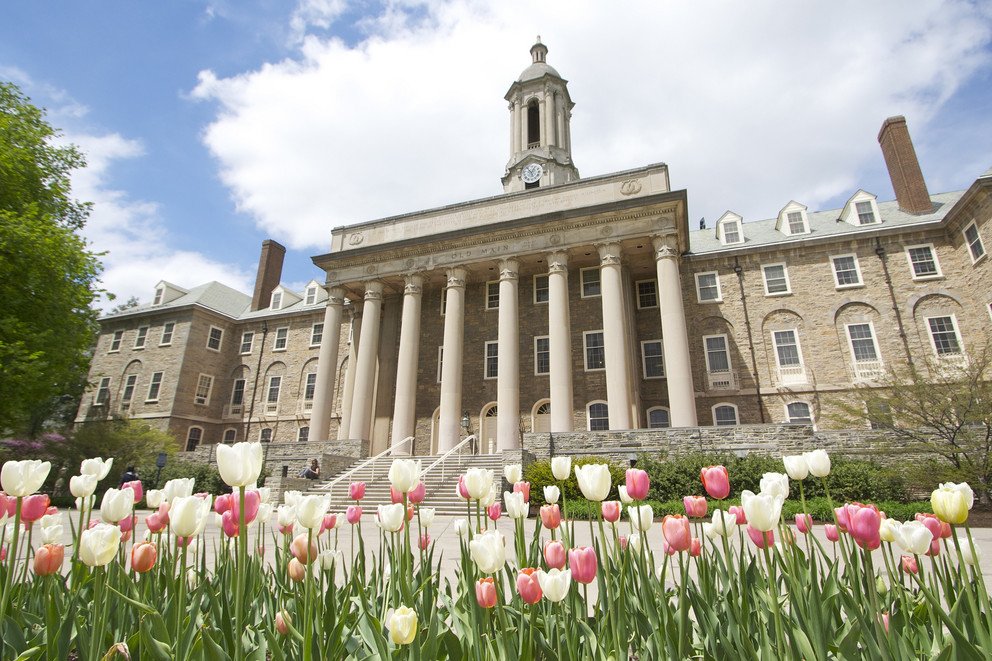
Kaitlyn Spangler (left), geographer, and Mook Bangalore, policy scholar, collaborators on an international groundwater project, walk in front of Old Main on the Penn State campus.
Discussions during each interdisciplinary project raise the curiosity of everyone involved. This approach builds community, encourages scientists to ask better questions, and nurtures creative problem-solving. It also speeds up the translation of findings into applied results.

IEE Associate Director and Distinguished Professor of Geography

Tracking Pollution, Protecting Communities
IEE research labs are advancing pollution control by developing innovative ways to treat wastewater and reduce environmental harm. By combining engineering and ecological principles, they’re creating more sustainable methods to manage contaminants before they reach natural systems.
In a related effort, researchers detected PFAS—so-called “forever chemicals”—in 65% of sampled private wells across Pennsylvania, revealing the widespread reach of emerging contaminants. This work is helping to map pollution, raise public awareness, and guide strategies to protect water quality statewide.
The Energy and Environmental Sustainability Laboratories (EESL) are shared multi-user instrumentation facilities managed by the Institute of Energy and the Environment. EESL ties together world-class instrumentation and expertise in a broad array of analytical techniques covering materials in all phases. Lab services are available to Penn State employees and students, outside academic/research institutions, and business and industry professionals.
Collaborating with the Environmental Contaminants Analytical Laboratory enables us to quickly develop new materials that can remove emerging contaminants, such as PFAS. The outstanding instruments and dedication to student mentoring makes this facility a key part of our research infrastructure.

Professor of Chemical Engineering

Li Li (left), hydrologist, and Hlengilizwe Nyoni, chemist, discuss equipment capabilities in IEE’s Environmental Contaminants Analytical Laboratory.
Learn more

Seeding Innovation
Learn how we support collaborative research across Penn State through our seed grant program.

Research Projects
Dive into research projects focused on climate, health, energy, communities, and water.
In the Spotlight
See how Penn State research is making headlines, from major discoveries to local impact.

Research Labs
Learn about our world-class instrumentation and analytical expertise.

Podcast
Our Growing Impact podcast explores science-based solutions for a changing world.

News Column
Penn State experts explore energy and environmental challenges and solutions