
About the Radiocarbon Laboratory
Penn State's Radiocarbon Laboratory provides radiocarbon measurements on carbon-bearing materials spanning the last 45,000 years. This includes materials such as wood, charcoal, bone, carbonates, and soils from the Pleistocene and Holocene time periods.
Work with the lab
The lab's services are available to Penn State researchers and external academic and industrial clients.

Capabilities
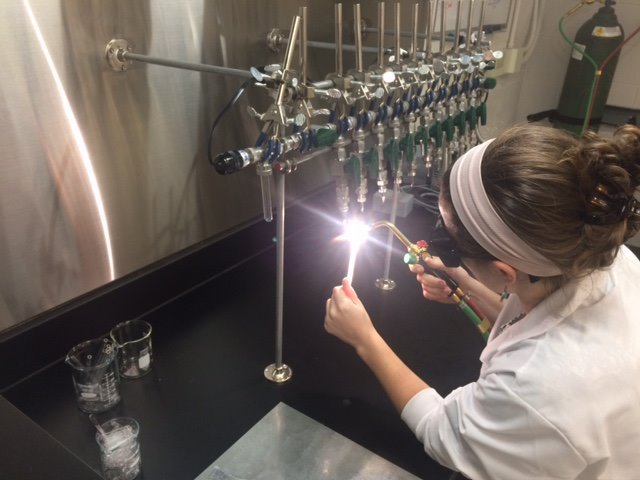
Sample preparation
Facilities to process almost any carbon-containing material
The Radiocarbon Prep Lab extracts and purifies carbon-containing samples from a wide variety of sample types including charcoal, carbonates, bone, and soil.

Accelerator Mass Spectrometry
AMS allows for high-precision 14C measurement on relatively small samples, with our optimal target being 0.7 mg of carbon. Lower precision 14C measurement is possible with smaller samples.

Research support
Our lab staff can assist with developing research designs, sampling strategies, and analysis of radiocarbon data at every stage of their projects from conception to conclusion.
Research applications
What is radiocarbon dating?
All living things contain radiocarbon or 14C. When an organism stops incorporating carbon from the environment into its cells and molecules—usually when the organism dies—the amount of 14C begins to decrease as 14C decays into nitrogen. The rate of this decay is also known as the half-life. Radiocarbon dating is carried out by measuring the ratio of radioactive 14C to stable 12C to estimate the age of organic carbon-containing material.
Our collaborations on interdisciplinary projects have been published in multiple journals, including Science, Nature Geoscience, PNAS, Quaternary Science Reviews, and Quaternary Research.
Fields of research
- Archaeology
- Geology
- Paleontology
- Paleoecology
- Art History
- Climate Reconstruction
Work With the Radiocarbon Lab
The Radiocarbon Lab is available to assist both Penn State researchers and external clients from industry, government, and other universities. Get started:
New clients
New clients that have not worked with the Radiocarbon Lab before can get started by submitting this form.
Experiment Design and Sample Selection
To ensure highly precise and accurate radiocarbon measurements, samples must be chosen carefully to answer your research question. If you have questions about which samples would be most informative, what types of samples should be collected and how, or what type of organic material from a mixed sample is the best to analyze, please ask the Radiocarbon Lab staff while you are selecting your samples. The more information staff have about your research question, the more we will be able to assist you.
The Radiocarbon Lab at Penn State offers preparation and high-precision 14C measurement on relatively small samples of the following materials.
| Material | Recommended amount |
|---|---|
| wood (unburned) | 20-100 mg |
| charcoal | 5-50 mg |
| bulk sediment/peat | 10-100 g |
| bone | 200-1000 mg |
| bone collagen | >5 mg |
| hair/fibers | 10-100 mg |
| carbonates | 25-50 mg |
| calcined bone | 1-5 g |
The Radiocarbon Lab produces precise and accurate radiocarbon measurements. However, that 14C/12C ratio will be most useful if your samples are carefully chosen to answer your research question.
Contact the Radiocarbon Lab staff with questions about samples, including which samples would be most informative, what types of samples should be collected and how, or what type of organic material from a mixed sample is the best to analyze. Please provide as much information about the research question as possible in order to allow lab staff to fully assist.
Our Guide to Radiocarbon Sampling is a handy summary of how to avoid the common pitfalls of radiocarbon collection.
In the News


Ready to Discuss a Project?
Connect with laboratory staff early to assess project fit, sample selection, preparation requirements and measurement goals.
Address
Radiocarbon Laboratory
Land and Water Research Building
781 Hastings Road
University Park, PA 16802