
Find the right lab capability for your project
The Institute of Energy and the Environment laboratory facilities connect researchers, industry partners, government agencies, and organizations with advanced analytical, imaging, and radiocarbon capabilities at Penn State. Whether you are investigating environmental contaminants, characterizing materials, visualizing internal structures, or establishing the age of carbon-bearing samples, our laboratories provide access to specialized instrumentation and experienced staff who can help design approaches, interpret results, and solve complex technical challenges. Explore the capabilities below to learn what each laboratory can measure, the techniques available, and how IEE Labs can support your next project from initial consultation through data delivery.
Advanced 3D imaging and non-destructive testing
Center for Quantitative Imaging
The Center for Quantitative Imaging provides high-resolution X-ray computed tomography and advanced non-destructive testing to help partners visualize internal structures, quantify material properties and solve quality or performance challenges.

Techniques
- High-resolution microCT
- Industrial CT scanning
- 3D volume reconstruction
- Digital segmentation and visualization
- Quantitative image analysis and measurement
What we measure
- Internal defects, porosity, inclusions and cracks
- Dimensional accuracy and geometric deviations
- Material distribution, density and structural uniformity
- Failure modes and degradation pathways
What you gain
- Accurate, non-destructive insight into internal structures
- Faster troubleshooting of product issues
- Higher confidence in material and component performance
- Data to support R&D, quality control and regulatory needs

Advanced chemical analysis for materials, products, and packaging
Environmental Contaminants Analytical Laboratory
The Environmental Contaminants Analytical Laboratory provides accurate, reproducible data that support product innovation, material safety, environmental monitoring, and compliance-related decision making.
Techniques and instrumentation
- Pyrolysis-GC/MS
- GC-MS/MS
- LC-MS/MS
- LDIR chemical imaging
- CIC for organic fluorine screening
What we analyze
- Microplastics and particle-bound chemicals
- PFAS and PFAS-related compounds
- Plasticizers and additives
- Flame retardants and residual monomers
- Trace contaminants and impurities
What you gain
- High-resolution chemical and compositional profiles
- Sensitive contaminant and exposure screening
- Insight into material performance and degradation
- Reliable, QA/QC-backed analytical results
Accelerator mass spectrometry at Penn State
Radiocarbon Laboratory
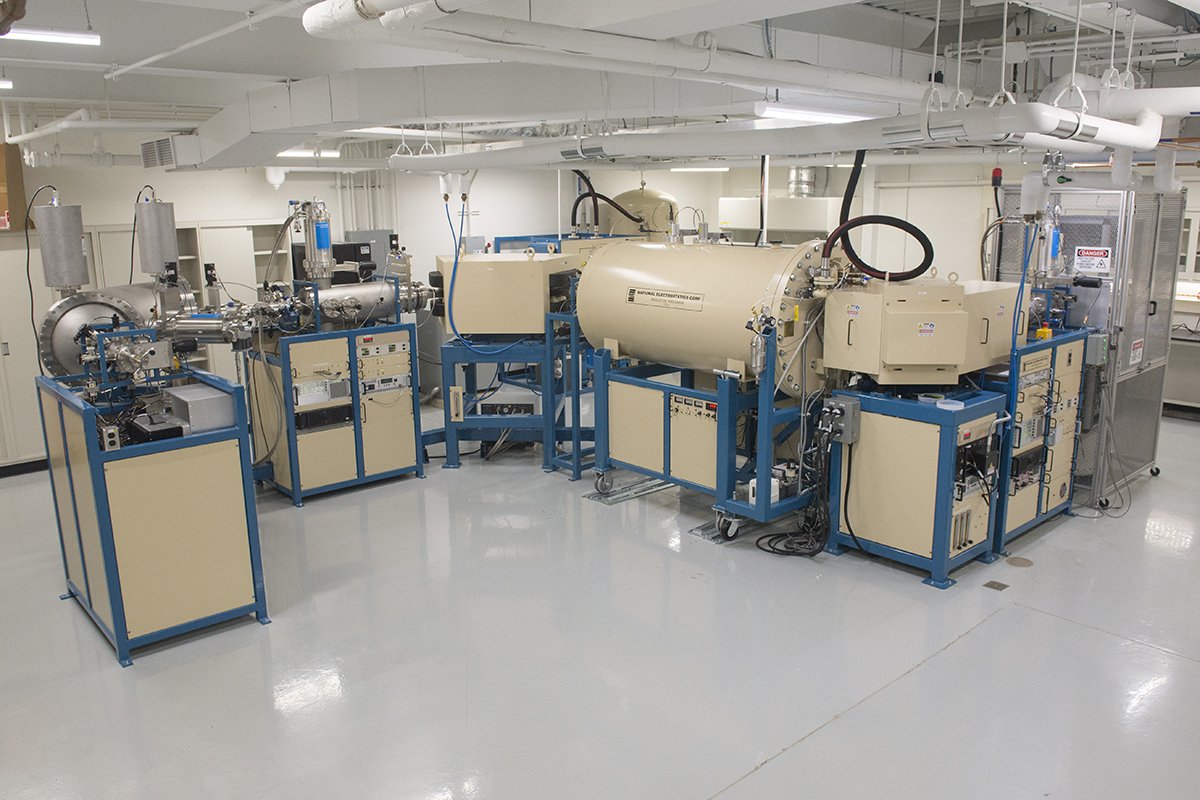
The Radiocarbon Laboratory provides measurements on carbon-bearing materials spanning the last 45,000 years, with support for research design, sampling strategy, and data interpretation.
Techniques
- Radiocarbon Accelerator Mass Spectrometry (14C AMS)
- Fourier Transform Infrared Spectroscopy (FTIR)
- Energy Dispersive Portable X-Ray Fluoresence (ED-pXRF)
What we measure
- Radiocarbon content of carbon-bearing materials
- Molecular composition of organic and inorganic matrices
- Quantitative and semi-quantitiative elemental composition
What you gain
- Understanding fundamental causal relationships between observed phenomena along the temporal axis
- Data supporting analyses of modes of production and use
- Data to inform provenance studies
Not sure where to start?
Contact us to discuss your research goals, sample needs, and the lab capabilities that best fit your project.