
Radiocarbon Prep Laboratory
The Radiocarbon Prep Laboratory at Penn State includes both dry and wet-lab areas for sample storage and preparation with standard laboratory equipment including:
- Fume hood
- Barnstead NanoPure water purifier
- Drying oven
- Freezer
- Freeze-dry lyophilizer
- Balances
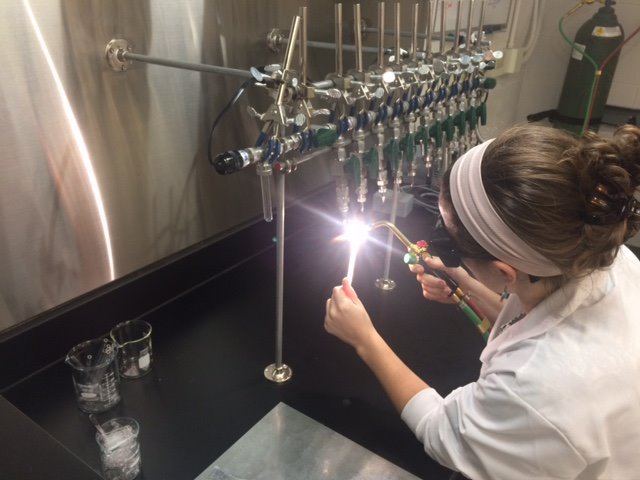
Sample preparation process
Extract and purify
The Radiocarbon Prep Lab extracts and purifies carbon-containing samples from a wide variety of sample types including charcoal, carbonates, bone, and soil. More information about how to send us samples, including a complete list of accepted sample types is available.
Combust and graphitize
Purified samples are then sealed on a vacuum line, combusted using a Barnstead programmable muffle furnace, and graphitized: combusted CO2 is converted to graphite via hydrogen reduction onto a Fe catalyst.
Laboratory systems and quality controls
The combustion and graphitization lines are made with Swagelok Ultra-Torr fittings on stainless steel drawn by oil-free Pfeiffer turbo pumps and have been modeled on lines in use at KCCAMS at the University of California, Irvine. The lab has been swiped for the presence of 14C tracer and maintains constant quality controls on radiocarbon processing with KCCAMS through use of international and internal known-age lab standards (e.g., OX-1, OX2, Prophet River Wood, Beaufort Whale, FIRI secondaries).
From preparation to measurement
Once graphitization is complete, AMS 14C measurements are made through the Radiocarbon Laboratory.
Ready to work with the Radiocarbon Laboratory?
Start with the project inquiry form, or contact the laboratory before preparing and shipping an existing project’s samples.